How Casinosss checks bonus codes and their conditions
Casinosss checks promo-code information against the conditions supplied for the exact promotion, the casino's published rules and, where available, retained account-screen observations. Those checks answer different questions: what an offer promises, what its rules require and what a particular screen showed. A listed code alone does not establish that a player received a reward or withdrew winnings.

What sits behind an offer description
- Exact offer conditionsWhat the personal promotion states
- Published casino rulesHow the stated procedure works
- Observed screenWhat appeared in that configuration
A useful check starts with the right offer. The same casino can have a personal code, a deposit promotion and a recurring reward with different rules. Matching the casino name is only the start; the code and reward must match too.
Conditions supplied for a personal code
Some personal-code conditions come directly from this site's owner. These can establish details specific to that promotion, such as its entry point, wagering base or promotion-specific cashout cap. We describe those conditions within that code's scope.
For example, the owner confirmed that the multiplier for the supplied personal free-spin offers applies to all winnings from the free spins. That answers what is multiplied. It does not add a spin value, change which balance funds wagering or remove a separate stake limit.
The casino's published rules
Published clauses explain the procedure the casino states: where winnings go, which balance funds eligible bets and what must happen before money becomes available for withdrawal. We retain the wording and its surrounding conditions so a short offer description does not lose the part that changes its meaning.
Vavada's free-spin rules, for example, put the winnings on a bonus balance and require activation in Bonuses. They apply 20x to the entire amount, with wagering funded by real money in slots. Receiving spins and funding the later wagering are separate stages.
A screen that was actually observed
An account view can establish that a field or option appeared in one configuration. Its scope includes the account region, wallet currency and action taken. A visible entry field establishes the entry point; successful submission, reward credit and a completed withdrawal each need their own evidence.
We keep that distinction when writing an instruction. Seeing where to enter a code is useful, but it cannot carry a claim about the outcome of entering it.
The Vavada check: a field was visible, a code was not submitted
An earlier read-only view of the owner's Vavada account showed a promo-code field under Bonuses. The account profile had Poland selected as its country and the wallet was in PLN. The retained observation records the field and its invitation to enter a promo code. No code was submitted, and the view exposed no reward conditions.
That supports a precise statement about the screen: a Bonuses entry field appeared in that account configuration. It does not establish that GET100 was accepted, that free spins were credited or that the offer is currently available to every player in Poland. Selecting PLN also provides no evidence about the value of each spin.
A separate reading of Vavada's public conditions covered the stated free-spin and withdrawal rules. It involved no authenticated cashier action, deposit, play, code redemption or withdrawal. The account observation and the published conditions are useful together, while each retains its own limits.
What a successful outcome would need
A successful reward claim would need evidence that the exact code produced the stated reward in the relevant account. A payout claim would also need the later withdrawal outcome. Neither follows from a code field, published processing time or an offer description. We do not present these retained checks as end-to-end redemption or payout tests, and they do not support a claim that the team redeems every listed code on a daily schedule.
The conditions have to cover each stage
Our editorial standard is to follow the reward through the stages that affect the player's decision. A correct spin count beside the wrong wagering rule still gives the wrong picture.
Identify the promotion. Match the casino, code, reward type and any named game. A personal free-spin code stays separate from a first-deposit match or a Telegram campaign at the same casino.
Check how it is received. Distinguish entering a code during registration from entering it later in Bonuses. Keep any additional qualification next to that action. A registration instruction does not establish country or account eligibility.
Follow the winnings and wagering. State the multiplier's base and the balance used for qualifying bets. Keep activation, spin use and wagering deadlines separate; a stated activation period is not automatically a deadline for playing the spins.
Read the cashout condition in its own scope. A promotion-specific cap, a maximum wagering stake and a daily withdrawal limit control different things. Removing one does not remove the others. Currency symbols also stay in their stated context; a bare dollar sign does not establish an account-currency equivalent.
The personal GET100 conditions for Play Fortuna and 1xSlots illustrate why those distinctions matter: code entry is during registration, with 14 days to activate, 7 days to wager and a maximum wagering stake of US$5. These are separate conditions. The supplied confirmation does not name the exact event that starts each clock or establish a separate spin-use expiry, so we do not turn them into a single invented countdown. Play Fortuna's US$5 conversion-deposit condition also stays with Play Fortuna; it is not a cashier minimum for 1xSlots.
One casino can have different cashout rules
Vavada provides a concrete example of why an offer needs its own identity. The personal GET100 description has no promotion-specific maximum cashout. That personal-code condition comes from the owner. Vavada's general rules separately set a ceiling of 10 times the accrued bonus for winnings formed by betting bonus money.
Personal GET100
The no-cap condition belongs to this personal promotion. Its free-spin winnings have 20x wagering on the whole amount, funded by real money. No promotion-specific cap does not mean instant payment or the removal of account checks and ordinary withdrawal limits.
General bonus-money rule
The 10x ceiling concerns winnings formed by betting bonus money. We keep that condition with the activity it describes. Applying it automatically to every reward at Vavada would erase the distinction between promotions and funding balances.
This is how we handle an apparent conflict: first establish whether the statements govern the same offer and the same activity. Where they differ in scope, both can be retained with their proper meaning. Where the same condition truly conflicts, the dependent claim needs a resolution before it can be stated confidently.
Read the full Vavada bonus conditions for the personal offer's reward, entry and wagering requirements.
A correction can add the step a player was missing
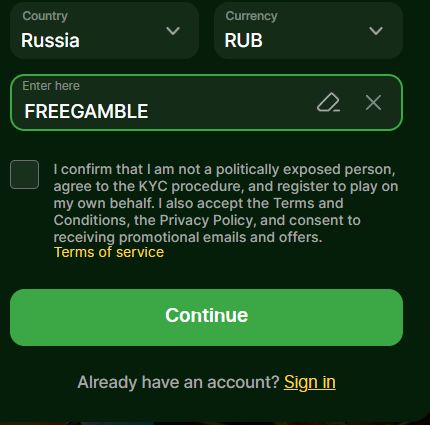
The entry instructions for Riobet and Vodkabet show a real correction in the information supplied to us. An earlier answer about other registration codes did not resolve these two offers. A later reply from the owner supplied their specific routes. We retained the earlier information and added the new instruction to the relevant promotion.
Riobet FREEGAMBLE
The code is entered during registration. Add promocode first appears as text; selecting it reveals the input. That detail explains why a player may overlook the field. The instruction belongs to FREEGAMBLE and establishes neither successful credit nor eligibility from a particular country.
Vodkabet GET50
The promo-code field is available during registration. Receiving the personal offer's free spins also requires linking your Telegram to the Vodkabet account. Keeping that prerequisite with the entry instruction gives the player the full action, without inventing a particular bot, link or button sequence.
The correction adds an entry route and a prerequisite. It does not replace GET50's 40x wagering on all free-spin winnings, funded with real money, with the conditions of a different Telegram promotion. Nor does a new entry instruction silently change the game's identity, cashout terms or country restrictions.
If an offer has changed
A code can be spelled correctly and still differ from the promotion shown in an account. The useful question is what changed: the entry point, reward, eligibility, deadline or withdrawal condition. A rejected code by itself does not tell us which of those caused the rejection.
Our correction standard is to examine the exact offer and the information showing the difference, then revise the affected instruction or condition. If reliable evidence establishes that an offer has expired, its active-offer promise should be withdrawn. If a material conflict remains unresolved, the disputed benefit should not be presented as settled. An earlier screenshot or description remains a record of its own context; it cannot establish current availability.
A page's last-updated stamp identifies its editorial revision. It does not mean every code was redeemed on that day. We make no promise of a guaranteed response time for corrections.
Send the detail that would change the answer
For a correction, provide the casino and exact code, the page where the information appears, and the condition or step that differs. Include the account country and currency when they explain the mismatch. A screenshot or the wording of the message can help show whether the issue is a missing field, an eligibility message, an expired promotion or a different reward.
Remove your name, email, account number, balance and payment details from any screenshot. Passwords, one-time codes and identity documents are not needed to report an editorial correction. For a missing reward or a withdrawal already in progress, contact the casino about the account transaction; a change to our article cannot credit or release funds.
Send the page and correction details through Contact us.
Use the no-deposit bonus selection to compare the offers themselves, then read the full conditions for the code you choose.
Questions and answers
Did the Vavada account check prove GET100 worked?
No. The view showed a promo-code field under Bonuses on an account set to Poland with a PLN wallet. No code was submitted, and no reward conditions were exposed. It did not establish GET100 acceptance, credited spins or a completed withdrawal.
Why is Vavada GET100 described as uncapped when a general rule says 10x?
The personal GET100 condition has no promotion-specific maximum cashout. The general ceiling is 10 times the accrued bonus and applies to winnings formed by betting bonus money. GET100's free-spin wagering is x20 of the whole winnings, funded with real money; removing a promotional cap does not remove ordinary withdrawal limits or account checks.
What details help Casinosss correct a bonus-code instruction?
Provide the casino, exact code, affected page and the condition or step that differs. Include account country and currency when relevant, plus the message wording or a screenshot. Remove personal, account, balance and payment details from screenshots; passwords, one-time codes and identity documents are unnecessary.