How casino random number generators are verified
Random number generators are verified by examining a specific implementation, testing its output and checking how those values become game outcomes. To judge a claim about a game, match the test record to its generator, mapping, rules and RTP configuration. That gives you a useful reading of the evidence before a laboratory logo does.

Follow the number all the way to the payout
An RNG produces random values. A game still needs to turn those values into cards, reel positions or another outcome, then apply its rules to settle the stake. The generator and the game's mathematical model have different jobs.
The GLI-19 version 3.0 technical framework distinguishes software generators, hardware generators based on physical events, and mechanical devices such as wheels or shufflers. The label "online casino game" does not identify which of these determines its outcome.
The conceptual flow is:
- Generator: produces the random values.
- Scaling and mapping: converts the available range into the game's selections.
- Game outcome: supplies the selected symbols, cards or other result.
- Rules and paytable: settle that result against the stake.
- Return: relates the resulting prizes to the cumulative stakes.
Scaling reduces a larger number range to the range a game uses. Mapping associates a value with a game symbol or object. Both belong in the examination because a sound generator can feed a faulty conversion.
Uniform random selection also does not make every visible prize equally likely. Where a game's design uses a non-uniform distribution, the final outcomes need to match that intended distribution. A rare symbol or feature can belong to the model; its rarity alone says nothing about whether the generator is behaving correctly.
What a laboratory examines
GLI-19 version 3.0 provides a concrete example of technical testing criteria. It describes source-code review and statistical analysis of final output, alongside requirements for resistance to prediction and other attacks. These are criteria for an examination. A product needs its own result showing what was examined and what passed.
Code, conversion and hidden influences
The code review covers the core generation algorithm, scaling, shuffling and other functions that affect the selected outcome. It looks for bias, implementation errors, malicious code and undisclosed switches or parameters that can influence randomness. Reviewing the generator while overlooking its mapping would leave part of the result-producing chain unexamined.
The implementation matters too. GLI's criteria call for separate evaluation where a game uses separate RNGs, and where otherwise identical RNG instances have different implementations within a game. A provider name shared by two games is therefore a weak substitute for the actual object named in a report.
Final output and the intended distribution
Statistical analysis examines outcomes after scaling, shuffling or other mapping. The laboratory selects tests for the particular generator and its use. GLI lists candidates including distribution or chi-square tests, overlaps, coupon collector, runs, interplay correlation, serial correlation and duplicates. A report must identify its own tests; that candidate list does not mean every certificate used all of them.
The framework says the applied tests are evaluated collectively at a 99% confidence level, with enough data to detect significant deviations frequently. That percentage describes the specified testing criterion. It supplies neither a 99% chance that a casino is honest nor a 99% chance of winning a bet. The data, method and purpose remain part of the result.
Independence and prediction
The independence criteria examine whether earlier draws reveal information about later draws and, where applicable, whether values within a draw reveal information about one another. Game design creates relevant exceptions. Selection without replacement, for example, changes the remaining possibilities after an item has been selected. Treating every card or feature step as an unrelated fresh draw would ignore the rules being tested.
GLI also addresses attempts to predict future output from past values, infer generator state from known inputs or exploit a compromised state. Its seeding criterion excludes a time value alone. Frequency tests and cryptographic examination answer different questions: output can appear statistically convincing while another part of the implementation needs examination.
Read an actual RNG certificate by its scope
The one-page iTech Labs certificate for Dribble Software Pvt. Ltd, signed 2 June 2023, is a useful example of a component record. It names YS TECH ANYTIME PRIVATE LIMITED as the operator. Read those identities as part of this particular historical document, rather than attaching its findings to another provider or casino.
The record's substantive fields are:
Statistical testing
- What the document says
- The generated numbers passed Marsaglia's diehard tests for statistical randomness.
- How to read it
- This is the laboratory's reported result for the examined component.
Scaling
- What the document says
- iTech Labs conducted scaling tests for a Dice game.
- How to read it
- The usage is specified; the exact Dice rules and implementation are not identified on the page.
Findings
- What the document says
- The sequences were described as unpredictable, non-repeatable and uniformly distributed.
- How to read it
- These are the document's findings, not a new test of a casino's current software.
Code identity
- What the document says
- The certified RNG code was fingerprinted.
- How to read it
- A fingerprint can identify code, but the public page does not print the fingerprint value.
Included scope
- What the document says
- Number generation and scaling/shuffling.
- How to read it
- This explains which parts of the generation chain the component statement covers.
Excluded scope
- What the document says
- Game rules and payouts require separate evaluation.
- How to read it
- The RNG certificate cannot supply the game's RTP or validate its paytable.
That final scope note changes the reading of the entire page. Even if the generator and Dice scaling passed the stated tests, the record expressly excludes evaluation of game rules and payouts. The certificate does not become a payout audit when its logo appears beside a game.
Choose the evidence for the question you have
iTech Labs distinguishes RNG and scaling certification, RNG-and-game certification, and audits of actual RTP/RNG from server logs. Those labels refer to different work. Match the question to the evidence before interpreting a result.
Does this implementation generate and convert random values correctly?
- Relevant examination
- RNG implementation and output testing
- Evidence it needs
- Code examination and representative final-output data, with the implementation and use identified
- What the conclusion covers
- The reported criteria for that particular implementation; payout rules and current deployed code need their own evidence
What return does this game model imply?
- Relevant examination
- Mathematical RTP/model validation
- Evidence it needs
- Probabilities, rules, paytable, selected configuration and mode, assessed by calculation or simulation
- What the conclusion covers
- Expected return for the defined model; a personal session can finish elsewhere
What happened in an actual body of play records?
- Relevant examination
- Actual RTP/RNG log audit
- Evidence it needs
- A defined dataset, game/configuration, period, play count, cumulative stakes and prizes
- What the conclusion covers
- The measurements and analysis of that sample; unreported settings and future sessions are outside it
Does a completed provably-fair result follow its committed inputs?
- Relevant examination
- Round reproduction
- Evidence it needs
- Pre-round commitment, disclosed inputs, exact game algorithm and recorded result
- What the conclusion covers
- Consistency of that particular calculation; generator quality and the game's theoretical return are separate questions
A logo does not identify all of this. The underlying record needs enough detail to connect its reported conclusion to the claim you are checking. Source-code review and a production code match also require information that an ordinary game-help screen cannot supply.
An RTP difference is a configuration question
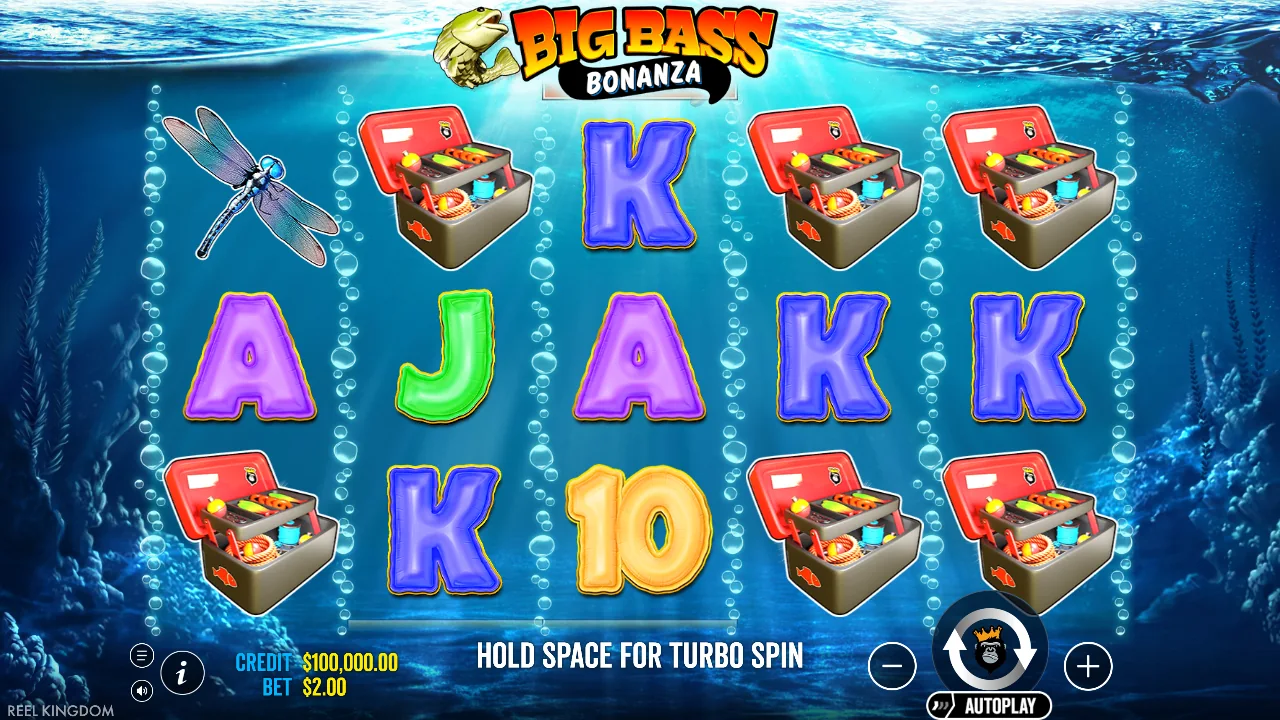
Original Big Bass Bonanza illustrates why a random-generator claim and a return percentage should be read separately. Pragmatic Play's product catalogue displays 96.71% RTP. A separate English native-help document for the original game displays 90.63% theoretical RTP.
These are two documented values with different contexts. The native-help artwork prints the £ symbol, but supplies no ISO currency code, build identifier or publication date. Its 90.63% figure describes that help configuration. The catalogue's 96.71% figure does not establish the setting served by a particular casino. Neither value should be substituted for the other simply because the game title matches.
RTP compares gross prizes with cumulative stakes. Cumulative stakes include amounts wagered again after a win; they are not the opening deposit or the final wallet balance. Theoretical RTP comes from a model calculation or simulation. Actual RTP comes from a defined set of recorded play.
The same hypothetical turnover, two model expectations
Take 1,000 cumulative stake units purely as an accounting example. No spins or simulated results are represented here.
Catalogue figure: 96.71%
- Expected gross return
- 1,000 × 96.71 / 100 = 967.10 units
- Expected net result
- 967.10 - 1,000 = -32.90 units
Native-help figure: 90.63%
- Expected gross return
- 1,000 × 90.63 / 100 = 906.30 units
- Expected net result
- 906.30 - 1,000 = -93.70 units
These are model expectations at the same turnover. They promise no session result, return on a deposit or chance of a winning spin. The units are generic accounting units, with no currency conversion.
An actual-return claim needs the game/configuration, the period and the number of plays behind its calculation. Its denominator must cover the same cumulative stakes as its prize total. A small personal run below the catalogue percentage cannot validate or disprove the model; a meaningful assessment needs the model's distribution and a suitable method. There is no universal spin count or tolerance that proves every game's RNG correct.
Find the relevant row in the game's own help before comparing it with a catalogue number. The practical RTP-setting guide explains that next task, and the original Big Bass Bonanza review provides the edition-specific configuration context.
A round verifier checks a completed calculation
SPRIBE's published provably-fair explanation describes a server-seed hash made available before a round, combination of server and player seeds into a SHA512 hash, and conversion of that hash into a result using mathematics specific to each game. Its example is for Mini Roulette. It does not supply a universal conversion from a hash to every SPRIBE game's outcome.
The documented player controls give you a place to inspect the relevant information:
- In SPRIBE's settings description, open Provably Fair Settings and find Next server seed SHA256, the hash commitment for the next server seed. The description also provides a client-seed control.
- For a completed round, open the game's history and use its provably-fair icon. SPRIBE describes a window containing the server seed, player seeds, combined hash and result.
- The separate Aviator rules locate settings at Game menu > Provably Fair settings and verification icons beside results in My Bets or Top. Those are documented controls for that native rule document.
To reproduce a round, you need the commitment that was available beforehand, the exact disclosed inputs and the actual game-specific conversion algorithm. Merely seeing a hash, or reproducing its digest, does not finish the result calculation. The generic SPRIBE explanation supplies neither the complete Aviator hash-to-crash formula nor all its input-handling details, so it cannot support an exact external Aviator multiplier calculator.
A successful reproduction of a completed round establishes that its result follows those committed inputs under the specified algorithm. It does not establish that every seed was unpredictable, validate the game's RTP model or predict the next outcome. Aviator's catalogue 97% RTP likewise does not provide a 97% chance of reaching a chosen cashout multiplier.
The provably-fair guide covers the separate commitment, reveal and reproduction task with a named worked procedure. Keep that procedure tied to its game and algorithm; an RNG laboratory record is a different kind of evidence.
What you can check as a player
You can make a useful check without attempting a laboratory audit. Begin with identification and records that are already available. Do not place extra bets to manufacture a test sample.
- Identify the game. Record the provider, full title and edition. Keep any visible build or configuration identifier and the selected ordinary, Ante or purchase mode. Similar artwork and a shared provider are not an implementation match.
- Read the relevant help. Locate the displayed RTP, paytable and mode rules. Keep a catalogue figure labelled as a catalogue figure. If the game-help value differs, preserve the exact row and its context rather than replacing it with the more familiar percentage.
- Read the named test record. Match the component or game identity, issuer, printed date and any version or fingerprint. Read the testing usage and exclusions. A statement about an RNG module answers a narrower question than a game-model report.
- Ask for the evidence your question needs. A randomness question needs implementation/output and mapping evidence. A payout-model question needs rules, probabilities, paytable and configuration. A past-round question needs its commitment, disclosed inputs and exact conversion algorithm.
- Describe a concrete inconsistency. Preserve the help value, mode/build, document identity and any relevant existing round or history identifier. Send the specific mismatch through the official support channel. An unavailable public report and a demonstrably inconsistent calculation are different findings.
If you have an RTP question, continue with the game's setting and the matching rules. If you have a completed-round question, continue with its exact verifier procedure. Each route gives you a concrete check whose conclusion stays tied to what it actually examines.
Browse casino game guides for the next game or rules question.
Questions and answers
What does the 99% confidence level in RNG testing mean?
Under GLI-19 version 3.0, the applied statistical tests are evaluated collectively at a 99% confidence level. It is a testing criterion, not a 99% chance that a casino is honest or that a bet will win. The data, method and purpose remain part of the result.
Does an RNG certificate prove a game's RTP or payouts?
Its scope determines the answer. The iTech Labs component record for Dribble Software Pvt. Ltd covers number generation and scaling/shuffling, while game rules and payouts require separate evaluation. That record cannot supply the game's RTP or validate its paytable.
What does reproducing a provably-fair round confirm?
It confirms that the completed result follows the committed inputs under the specified game algorithm. The check needs the prior commitment, exact disclosed inputs and game-specific conversion algorithm; matching a hash alone is insufficient. It does not establish that every seed was unpredictable, validate RTP or predict the next outcome.